
Places
Science Inside a Hundred-Year-Old School
To remember
At Carasso Park genetics is taught inside rooms built in 1914 in order to teach agriculture.
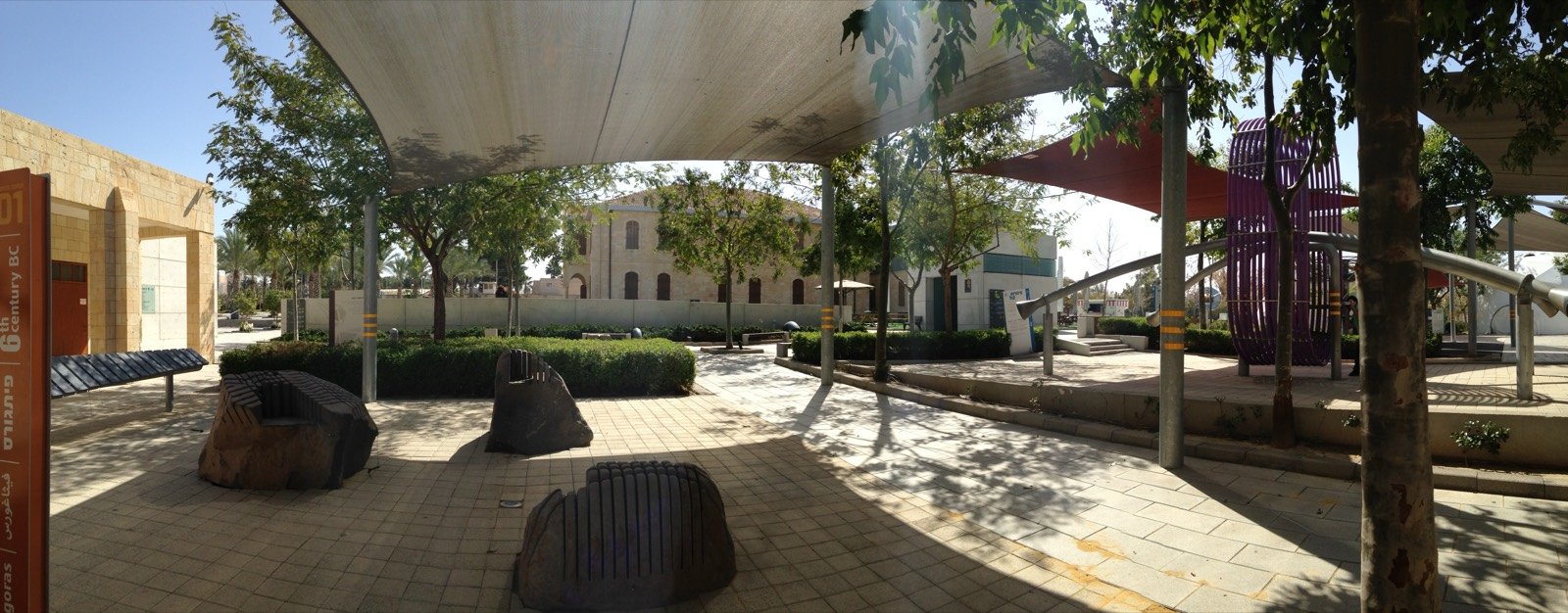
At the edge of the Old City, on the museum boulevard, a science museum is spread over seventeen dunams. Its name is Carasso Science Park.
It was established by the Rashi Foundation, the Beersheba municipality and the Ministry of Education, in cooperation with Mifal HaPayis and the Carasso family, and it opened to the general public in a ceremony held on 30 June 2013, in the presence of the President of the State Shimon Peres.
And what makes the place special is not only what is inside it, but what it occupies. The compound holds buildings from three periods: from the Ottoman period, from the period of the British Mandate, and from the period of the state.
And some of the display halls are housed inside the building of the school for Bedouin children, which was built in 1914 and has stood here a hundred years before the exhibitions.
That is, genetics and semiconductors are displayed in rooms that were originally built in order to teach the children of tribes agriculture. It is the same building, with the same arches, and inside it an entirely different subject.
And it stands on the Gustav Levan campus, beside Beit Yatziv and the Ma'of school — that is, inside a cluster of educational institutions, and not alone in a field.
And 'interactive' means something simple: an exhibit that waits for you to do something to it. You turn, you press, you switch on — and it answers. Such an exhibition does not tell you what happens; it lets you make it happen.
And the park has about ten such exhibitions. Light and the sense of sight. Sound and hearing. Energy. Communication. 'The Code of Life', on molecular biology and genetics. 'The Nucleus of Science', created in cooperation with the Nuclear Research Center and simulating a reactor. 'The World of a Chip', on Israeli high tech and on semiconductors. 'Plant Protection', on the global food challenge. And a separate area for toddlers, who cannot yet reach the other exhibits.
And in the courtyard outdoor displays are scattered that teach physical principles through the body itself: a lever, a magnetic pendulum, sound dishes, a rocket engine. And beside them a garden of science games.
A Fab Lab also operates at the place, with about fifteen three-dimensional printers.
And the whole place is spread over seventeen dunams, and you can spend a whole day in it without passing twice through the same exhibition.
And in 2020 a large pipe organ was donated to the museum, built by Gideon Shamir and which had stood in the house of the composer Ami Maayani.
Sources
- Photograph: שפרעברג · CC BY-SA 4.0
- Photograph: סימונה מדימונה · CC0