
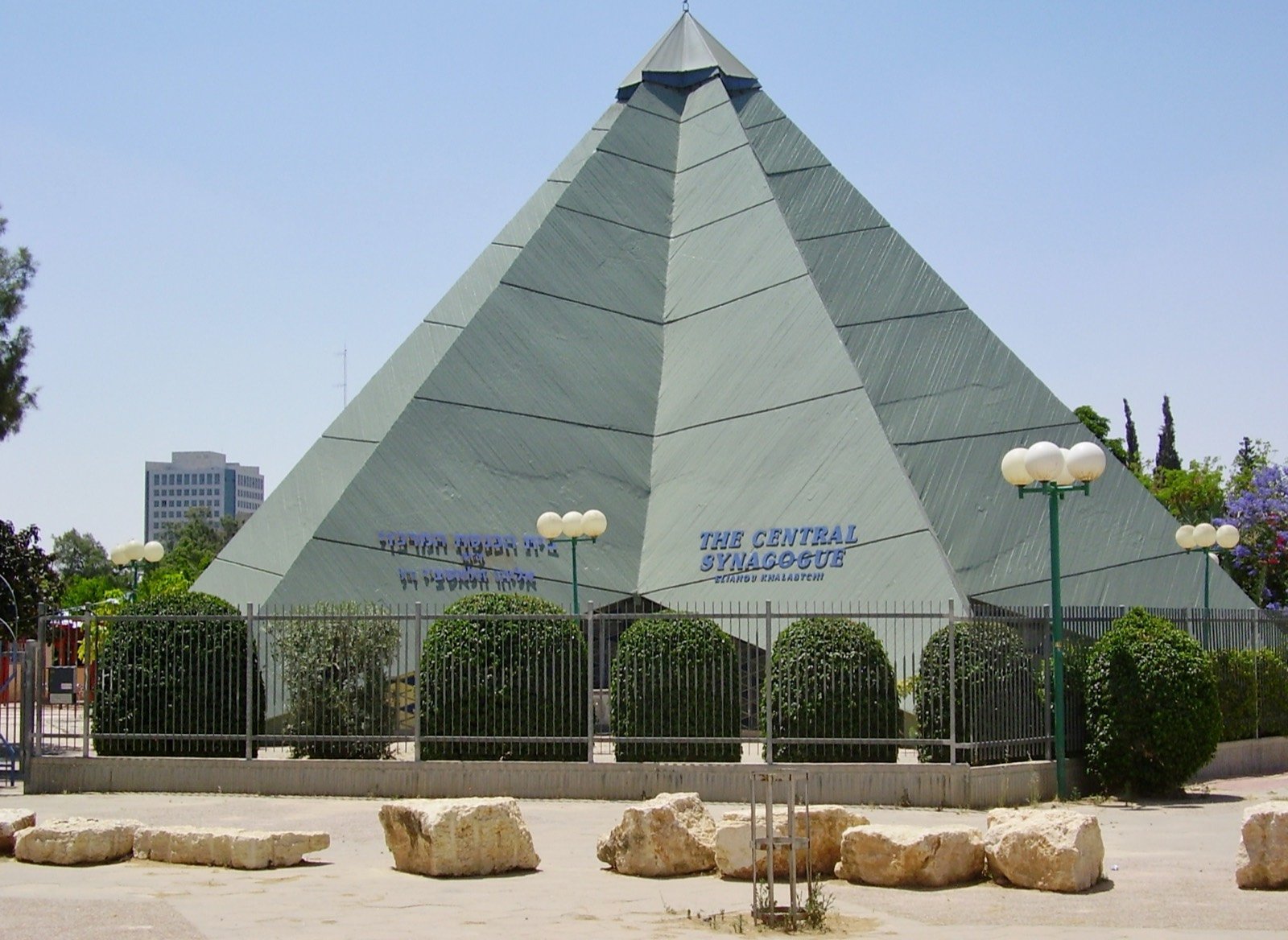
The Pyramid Synagogue
The central synagogue for the Jews of Iraq named after Eliyahu Khalastchi
The story
The central synagogue for the Jews of Iraq named after Eliyahu Khalastchi, known by the nickname the Pyramid synagogue, stands in Neighborhood Alef and serves those who came from Iraqi Jewry. The form of the building is a kind of tent, and the inspiration came from the Tent of Meeting; the triangular form also recalls a pyramid, and hence the nickname. In the 1970s Eliyahu Navi, mayor of Beersheba and himself of Iraqi origin, succeeded in enlisting the London businessman David Khalastchi, also of Iraqi origin, for the erection of a building for the Iraqi community that would replace the old and small wooden structure put up by Hakham Moshe Dali. The cornerstone was laid on 30 April 1975; Ezra Yeruham and Yaakov Dagmi led the construction, and the building was dedicated on 7 September 1980 in the presence of the city's leaders and its rabbis, the Chief Rabbi of Israel and the Minister of Religious Affairs. The building rises to a height of eighteen meters and was designed by the architect Nahum Zolotov in the Brutalist style. Originally they aspired to a building thirty-two meters high, in which the women's section would float above the men; for want of budget the present building was built, in which the women's section is on the level of the worshippers and a partition that is not solid separates them. Its form recalls a Star of David, which from the front looks like a large pyramid, and at its apex is a transparent cover that is lit by floodlights on festival nights. It stands on six points of reinforced concrete anchors dug to a depth of six meters. In 1983 the Philatelic Service issued a stamp bearing the synagogue, in the design of Asaf Berg, in the series “Moadim LeSimha 5744”.
Read onPerhaps this too
At the place itself the stamp also gets a postmark with the date.
Sources
- בית כנסת הפירמידה — ויקיפדיה העברית Accessed 2026-08-11
- בית כנסת הפירמידה (Q12404562) — Wikidata Accessed 2026-08-11
- המרכזי לעולי בבל — רשימת בתי הכנסת של המועצה הדתית באר שבע (מונטיפיורי 5; a entrada que corresponde a esta casa, ver pendencias) Accessed 2026-08-13
Photographs
- ד"ר אבישי טייכר — PikiWiki Israel CC BY 2.5
