
The Oren Cinema
The Oren cinema stood in the north of Neighborhood Dalet
The story
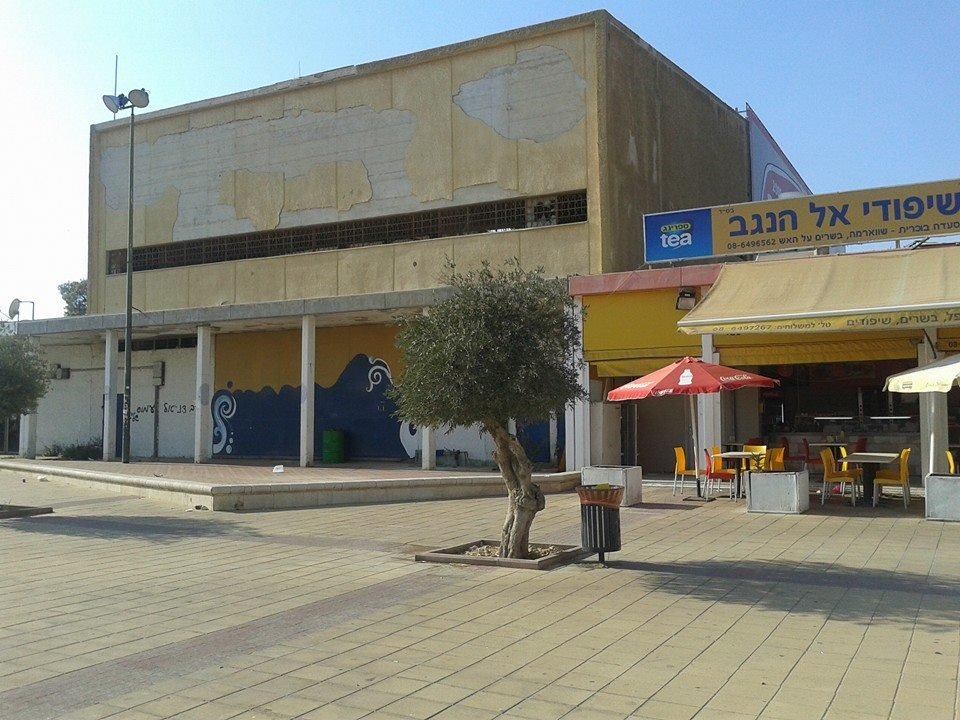
The Oren cinema stood in the north of Neighborhood Dalet, at the northern entrance to Beersheba, on ground of about a dunam and a half; its eastern front faces Yitzhak Rager Boulevard and its northern front Gan Yonatan. In the 1970s and 1980s it was considered one of the large and popular cinemas in the city. Four investors — Uri Nissim, Yitzhak Nahum, Ezra Yeruham and Menashe Meir — bought in June 1972 a building that had already been built as a cinema, in a commercial center that was then called “Center Vav”. They called the cinema Oren, and afterwards the whole center was named after it. The premiere screening was in September 1972. Those same investors also held the Eshel cinema in Beersheba and the Heichal and David cinemas in Herzliya, and therefore could acquire the most sought-after films. In the screening hall there were 817 seats, and in the projection room two machines that worked on carbon: at the end of one reel the second was set going, in order to keep the continuity of the screening. Six people worked in the cinema, and two more ran the refreshment counter independently. The tickets were issued by the municipality and entertainment tax was paid on them, and the minimum number of viewers for a screening was eight. On Fridays Indian and Turkish films were screened, and tickets were sold in a quantity 50% greater than the number of seats — some of the viewers sat on the steps in the aisles. The cinema had four exits, and two of them served as a public shelter; in the Yom Kippur War, in 1973, they were used. In that same year a fire broke out in the roof, apparently from an electrical short circuit. The roof was repaired, but the stage, which was damaged too, was not repaired, and since then no plays were put on in the cinema. In 1994 the activity was stopped and the building was sold to a German company for 400 thousand dollars, and since then it has been sold twice more. In 2006 the ground was acquired by real estate developers who planned in its place a residential tower of 24 floors with 314 apartments in it; the plan did not come to pass. The building stands abandoned, its front covered with graffiti inscriptions, and in its lower part shops operate.
Read onPerhaps this too


At the place itself the stamp also gets a postmark with the date.
Sources
- קולנוע אורן (באר שבע) — ויקיפדיה העברית (os quatro investidores e a compra em junho de 1972, a estreia em setembro, os 817 lugares, as duas maquinas a carvao, o imposto de diversoes e o minimo de oito espectadores, as sextas indianas e turcas, o incendio de 1973 e os dois abrigos, a venda de 1994 por 400 mil dolares e o projeto de 2006) Accessed 2026-08-14
- קולנוע אורן (Q18191330) — Wikidata (coordenada e o ano de 1972) Accessed 2026-08-14
Photographs
- Danny-w CC BY-SA 4.0
- קוקי חוה קוקי CC BY-SA 4.0

