
Animals
The Scorpion That Comes Out at Night
To remember
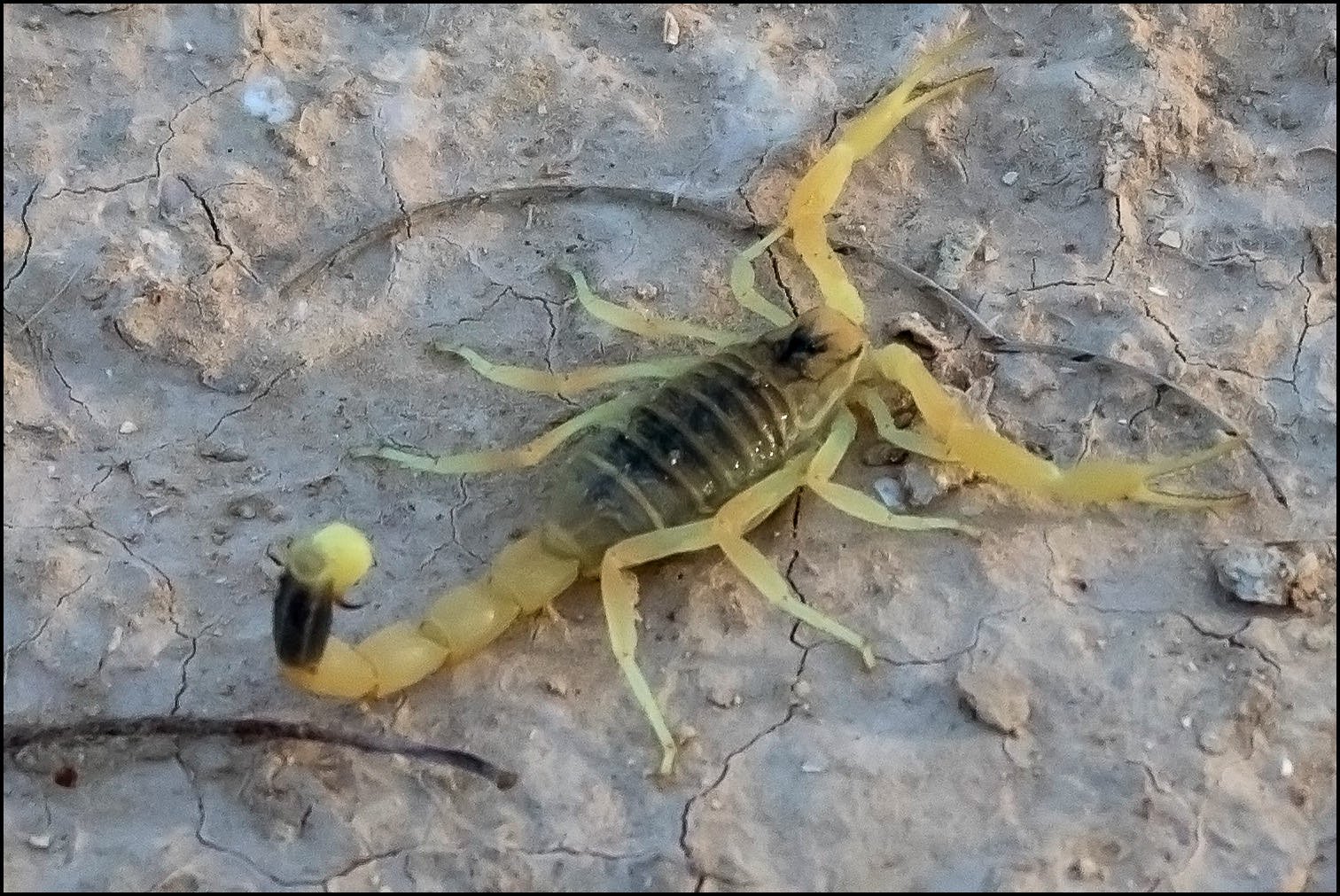
The yellow scorpion is the most venomous in Israel, and it is nocturnal — by day it hides under stones.
The yellow scorpion is the most venomous scorpion in Israel, and its body length reaches 9 to 11.5 centimeters.
And let us start precisely with what it is not. A scorpion is not an insect. Insects have six legs; a scorpion has eight, and it belongs to the same large group in which the spiders are too. And its 'tail' is not a tail either but a continuation of the abdomen, and at its end sits the sting.
It is nocturnal. By day it is in shelter — under a stone, inside a crack, in a hole in the ground — and at night it comes out to roam and to look for prey, and returns to shelter before morning. And that is an adaptation to the desert before it is a hunting method: by day the surface of the ground is too hot.
In Israel it is found almost everywhere, except for the Carmel, the sands of the Judean lowland and areas of heavy soil. That is, in the Negev — yes, and plenty.
And now the part parents ask about. Its sting is very painful. In a healthy adult it is usually not life-threatening, but it is genuinely dangerous to small children, to the elderly, to people with heart problems and to anyone who has an allergy. That is, this is not 'no big deal', and it is not a horror story either. It is something that has to be taken seriously.
And there is another interesting thing about this scorpion, and it concerns its name. It is called yellow because its body is light-colored, and a light color in the desert is no accident: it absorbs less heat, and it also hides well against a background of sand and stone. A scorpion you do not see is a scorpion that did its job properly.
And what is true is this — a scorpion does not chase people and does not attack them. It stings when it is cornered: when someone steps on it, when a hand is put on it without seeing, when it is caught inside a garment.
And from that three simple habits follow, and all of them are easy. You do not turn stones over with a bare hand. You shake out shoes and clothes before putting them on, especially after sleeping out in the field. And you walk with a flashlight at night, because that is the time when it is outside and you are not.
And if you have been stung all the same — you turn to medical help at once. If possible, you photograph the scorpion from a distance without touching it: identifying the species helps the doctors decide what to do.
Sources
- עקרב צהוב — ויקיפדיה העברית
- Photograph: מינוזיג · CC BY-SA 4.0