
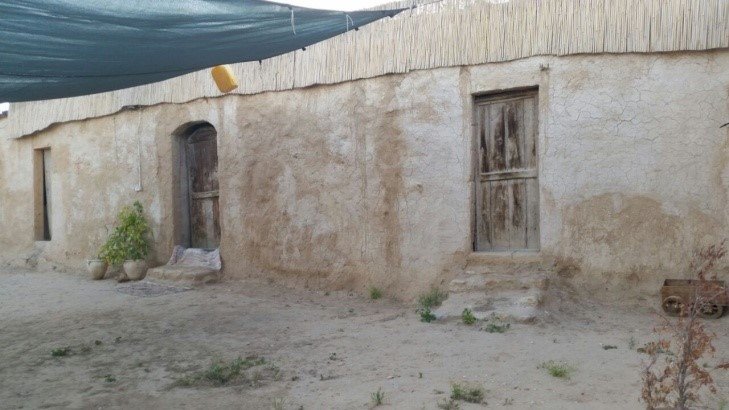
Al-Huriya Palace
A building from the period of Ottoman rule
The story
Al-Huriya Palace (Arabic: قصر الحوريه) is a building from the period of Ottoman rule, in the Bedouin town of Lakiya in the northern Negev. The building belongs to the Abu Qarn family, and the visitor center in it is run by Amal Abu Qarn, a daughter of the family. According to the family tradition reported by the source, one of the family's forefathers dealt in the sale of spices in Gaza at the beginning of the 18th century, came in the course of his work to the area of Lakiya and Beersheba and decided to remain in it. Once he had grown rich he turned to a Christian craftsman, who designed and built him a magnificent house in exchange for several kilograms of gold, and thus the place became the first khan in the Negev region. In times of war the building served as a shelter for most of the village's inhabitants. It is built in ecological construction of stones, mud and straw, and part of it was built into the side of the hill; it is divided into spaces separated by arches in which families lived, in the middle stayed the camels, the donkeys, the horses and the sheep, and at the side implements and food were stored. The roof of the building is made of three layers — trunks and branches of pine, matnan shrub, and mud and straw — and it requires annual maintenance. There were also a hammam and a water well at the place, which were considered a symbol of wealth. At first the building was called the Hajj's Palace, since that is what the villagers used to call it, and after the death of Amal's grandmother it was decided to name it after her. The building was abandoned in 1990 and reopened in 2008, and it serves today as a visitor center and a social tourism business that supports the empowerment of Bedouin women.
Read onPerhaps this too
At the place itself the stamp also gets a postmark with the date.
Sources
- ארמון החוריה — ויקיפדיה העברית Accessed 2026-08-10
- ארמון החוריה (Q20502244) — Wikidata Accessed 2026-08-10
- File:ארמון החוריה 1.jpg — Wikimedia Commons Accessed 2026-08-10

Photographs
- Mechola fc CC BY-SA 4.0