
Places
A Monument You Are Allowed to Climb
To remember
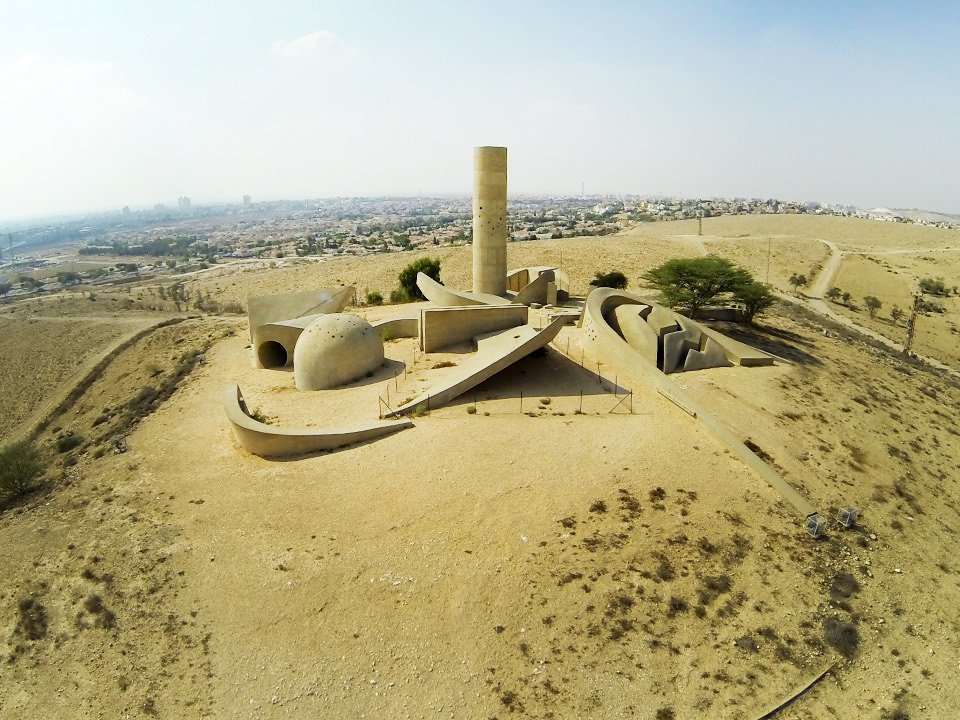
Dani Karavan pierced the observation tower with holes so that it would sound in the wind, and he said that he wanted children to climb on the monument.
On a chalk hill in the east of Beersheba stands the Negev Brigade Monument. It looks west toward the city, and out to the desert on all its other sides, and it is one of the recognized symbols of the Negev.
It commemorates the work of the Palmach's Negev Brigade in the War of Independence, and first of all the defense of the water line to the Negev.
And what is the water line to the Negev? A pipe. The isolated settlements of the Negev did not have water of their own in sufficient quantity, and the water reached them through a long pipe from the north. A pipe can be cut at one point, and everything on the other side of it dries up. So guarding a water line is not a side task in the desert — it is the task.
The monument was designed by the artist Dani Karavan, and the landscaping work was done by the landscape architect Zvi Dekel. It was built between the years 1963 and 1968, of exposed concrete, and its style is Brutalist — that is, the concrete stays visible, without covering and without paint.
And it is not one sculpture but eighteen elements, and each one is connected to the brigade and to its battles.
It has a perforated memorial dome, through whose slits the rays of the sun penetrate and light up the names of the fallen. It has an observation tower eighteen meters high, in which Karavan pierced holes in the form of shell holes — so that it would sound when the wind blows through it. It has a water channel that leads to a small pool, in memory of the water pipeline the brigade guarded. It has trenches that imitate communication trenches. And it has battle diagrams cast into the ground.
And engraved in the concrete and in the copper plates set into it are the names of the fallen, the emblem of the Palmach, the brigade's campaign diary, verses and poems.
And about his intention Karavan said something that is not usual in monuments. He said that he wanted a place that creates life and not a place of death and remembrance — and that children would play inside the monument and climb on it.
That is, this is a monument that was built with the intention that people would climb on it.
And adjoining it there is a national park of two hundred and ninety-five dunams, in which the plant community characteristic of the steppe belt is preserved. And in the month of March the brown iris blooms in it, and that is probably the best time in the year to go up this hill.
Sources
- Photograph: Guymeg · CC BY-SA 3.0