
Plants
A Flower That Grows Here and Nowhere Else
To remember
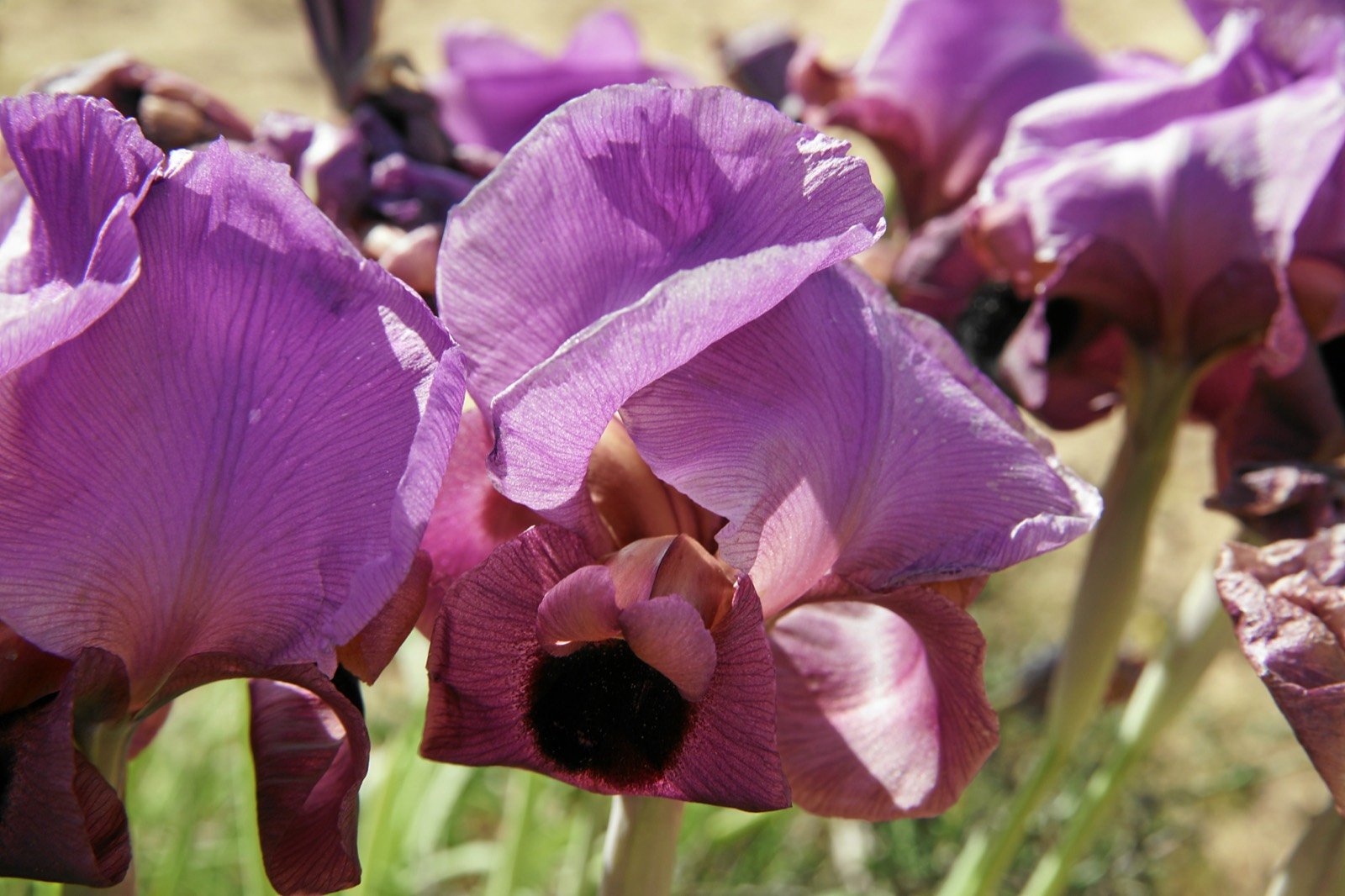
The Negev iris is endemic — it grows in southern Israel and in Egypt only, and nowhere else in the world.
The Negev iris is a large purple flower that grows in the sands, and it almost does not exist anywhere else in the world.
'Almost does not exist anywhere else' is an exact expression in biology, and it is called endemic. An endemic species is a species that grows in one region only. The Negev iris is endemic to southern Israel and to Egypt: it grows in the sands of the central and western Negev, and from there as far as El Arish. And that is all. There is no Negev iris in Europe, in Asia or in America.
Its flowering is short. It blooms in February and in March, and the exact date depends on the weather of that year. Whoever wants to see it has to come in the right weeks; for the rest of the year it is under the sand, and it cannot be seen at all.
The color is purple in various shades. The outer petals are darker than the inner ones, and below, at their base, there are dark spots.
And what hides under the sand is the part that keeps it alive: a rhizome. This is an underground organ that stores food and water, and it is what lets the plant get through the long, dry summer without leaves and without flowers and come back in the winter after it.
And the sand itself is part of the story. Sand looks like a hard place to grow in, and in some ways it is actually convenient: water goes through it quickly and does not stay on the surface to evaporate, but goes down and is kept there at depth. A plant that knows how to reach it gets a reservoir. A plant that does not know — has nothing to look for there. The Negev iris knows.
The Negev iris is a protected flower, and three dangers stand against it. People pick it, because it is beautiful. Building and development take the sands it grows in. And the third is surprising — rodents dig up and eat its rhizomes.
And an endemic species in danger is a special case, and it is worth understanding why. If a species that grows in twenty countries disappears, it disappears from one country and goes on living in the rest. An endemic species has no 'rest'. If the Negev iris disappears from these sands, it will disappear from the world.
And so the rule is very simple: you look, you photograph, you do not pick. A picked iris is not preserved and does not continue; it wilts within a day. And the rhizome that stays in the sand is all that will be there next year.
Sources
- אירוס הנגב — ויקיפדיה העברית
- Photograph: Mboesch · CC BY-SA 4.0