
Animals
The Ibex That Climbs What Cannot Be Climbed
To remember
In the whole world there are about 2,500 Nubian ibexes, and about a thousand of them live in Israel.
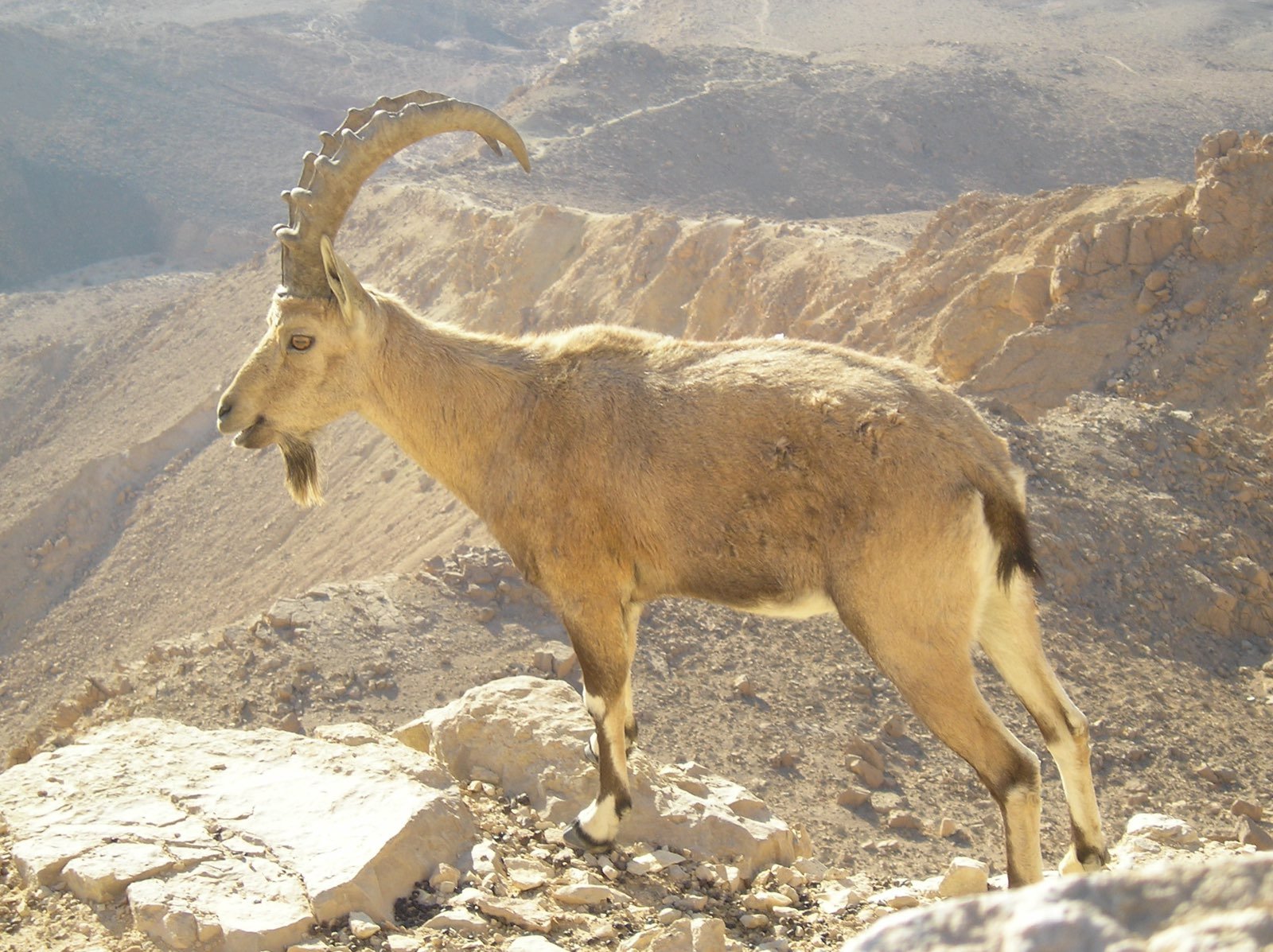
The Nubian ibex is a wild goat, and it is the animal photographed in the Negev more than any other — because it climbs cliffs that look completely smooth, and does it without hesitating.
And where does it live? In Israel you can meet it in the Negev, in the Judean Desert and in the Eilat mountains. Outside Israel there are populations of it in Jordan and in Oman.
The first thing you see in an adult male is the horns. They are curved backward, and their length reaches up to 130 centimeters — more than a meter and a quarter, on an animal that is not especially large. The females have horns too, but much shorter, and so you can tell them apart from a distance already.
And its social life is surprising. The ibexes live in herds, but a herd of males and a herd of females live separately from each other. In each herd there are up to about twenty individuals. The females and the kids in one group, and the males in another group, most of the year.
And now the number, and this is the number worth remembering. According to estimates from 2021 there are in the whole world about 2,500 Nubian ibexes. Of them about a thousand live in Israel.
That is, close to 40 percent of all the Nubian ibexes there are in the world are here. That is a very small number for a whole species, and so its conservation status is defined as 'vulnerable'. And it also means that protecting it in Israel is not a local matter: what happens to the ibex here changes its condition in the world.
And what is 'vulnerable', really? It is one of the grades by which species are ranked according to the risk that they will disappear from the world. 'Vulnerable' is not the most severe grade, and it is also not a sign that everything is fine. It says one thing: this species is on the wrong road, and it is still possible to stop it.
And there is one thing you can do for it, and it sounds small. An ibex that gets used to receiving food from people — from a table, from a rubbish bin, from an outstretched hand — stops looking for food by itself, and starts coming close to towns and to roads. An animal that eats from the hand is no longer a wild animal, even if it looks exactly the same. So you do not feed it, and that is true even when it stands close and looks as if it is asking.
And the sight of it on the cliff is worth the wait. An ibex going up a steep slope does not leap from rock to rock. It finds in the slope a path that you simply do not see.
Sources
- יעל נובי — ויקיפדיה העברית
- Photograph: Little Savage · נחלת הכלל