
Places
A School That Opened as a Hospital
To remember
The building was built as a school in 1914, and opened first of all as a hospital.
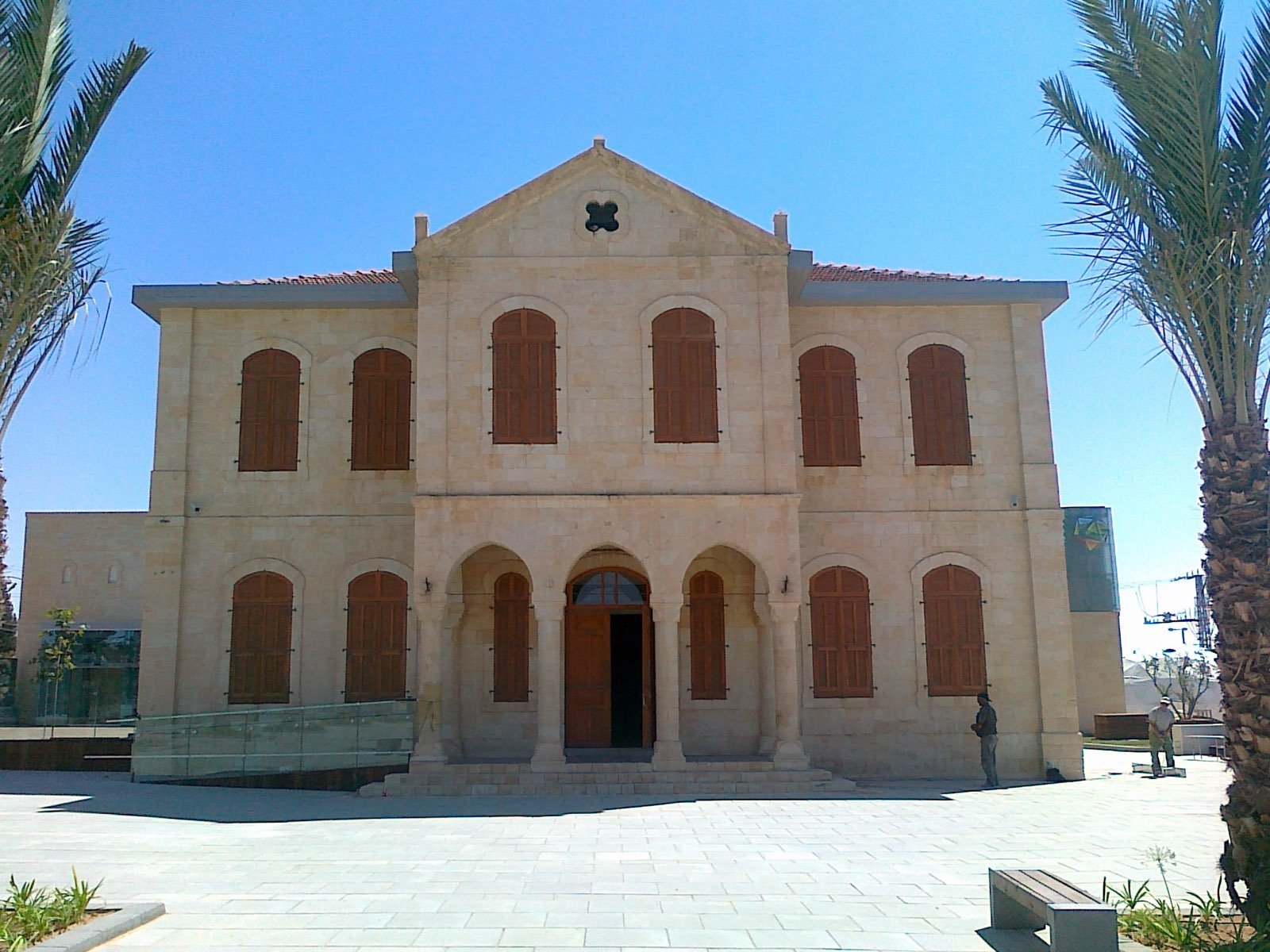
In the west of the Old City, on Hativat HaNegev Street, stands a symmetrical two-story building with a tiled roof. Its entrance has three arches, and they open into a large hall.
The Ottoman government planned it as an agricultural school for the children of the Bedouin who lived in the surroundings. The intention was declared: to turn them, by means of education, from nomads into tillers of the soil in permanent settlements. And until then there was no organized school in the Negev region at all.
And the building itself is typical of the Ottoman public buildings in the city: two floors, symmetry, a tiled roof and a central entrance. And it also has a rear entrance, with stairs that go straight up to the second floor — a small detail that explains how the two floors could be run separately from each other, and that is exactly what happened in it later.
The plan came up early. Already in 1908 the pasha spoke about it before the sheikhs. But the construction began only in 1913, and was completed in 1914.
It was built in the form of a boarding school, in order to make things easier for distant tribes — a child who lived far away could sleep in it.
And in its original purpose it did not open. The First World War broke out, and the building was converted into a Red Crescent hospital. It took in mainly epidemic patients from the Ottoman army, and in the winter of 1916 the mortality in it was so great that soldiers did all they could not to be hospitalized in it.
Only in the Mandate period did it return to serve as an elementary school, and so for about thirty years: boys on the first floor, girls on the second floor.
And even then the original intention was not fulfilled. Its pupils were mainly the sons of the families of the officialdom and of the noble families among the tribes of the area — and hence the nickname that stuck to it, the school for the sheikhs' children. Most of the Bedouin children in the Negev did not study in it.
In May 1948 the Egyptian army placed its headquarters in it. The building was damaged, was repaired, and in June 1949 the Soldiers' House was dedicated in it.
And since 2013 it has been part of Carasso Science Park — that is, inside it science is studied today, a hundred years after it was built in order to teach agriculture.
Sources
- Photograph: BAswim · CC BY 3.0
- Photograph: D. Macaulay · נחלת הכלל