
Climate
A Dry Streambed That Fills
To remember
In the Eilat mountains about 10 millimeters of rain is enough for a flood to occur — and the rain can fall dozens of kilometers away.
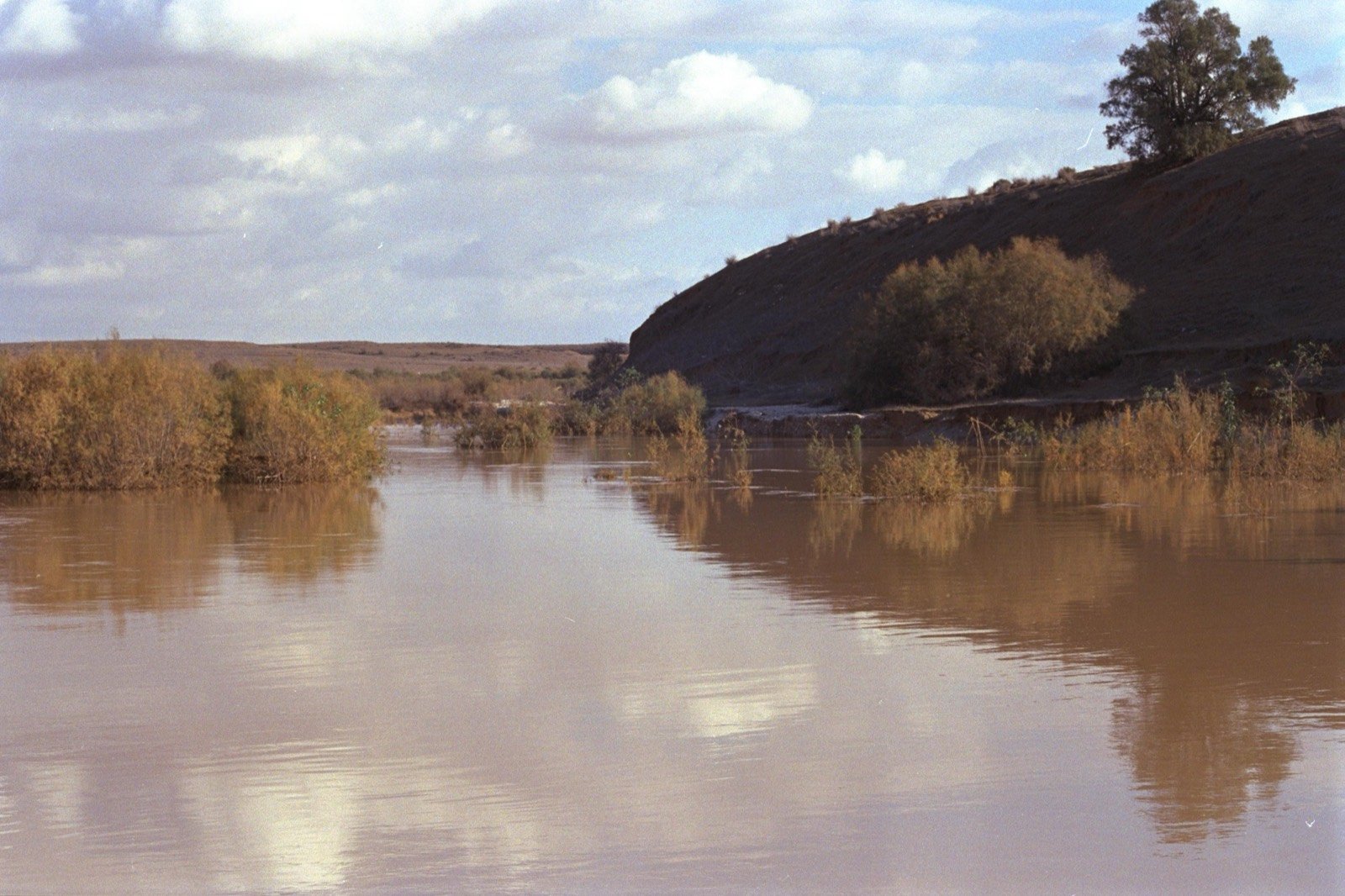
A stream in the desert can be completely dry, and within minutes fill with water. That sounds like a story, and it is what happens here every winter.
The reason is in the ground. In a desert region the soil is shallow, the rock is exposed and the vegetation is sparse. In a place that has deep soil and roots, the rain is absorbed slowly. In the desert the water has nowhere to be absorbed, and so it flows over the surface — fast, and all of it together, to the lowest point. The lowest point is the streambed.
And how much rain is needed? Less than it seems. In the Eilat mountains a flood may occur after only about 10 millimeters of rain have fallen. 10 millimeters is light rain in the north of the country. In the desert it is enough to fill a wadi.
And here is the most important thing to know about a flood, and it is also the dangerous one. The rain does not have to fall on you. It falls in the drainage basin — the whole area that drains its water to that stream — and a drainage basin can begin dozens of kilometers away. You can stand in the sun, under a completely blue sky, and see water arriving from a direction where rain is falling and you cannot see it.
The flood also ends fast. In most of the streams in the desert it finishes a very short time after the rain stops, at most a few hours. In large drainage basins it can last a few days.
The flood season is the rainy season, from October to April. In this season trails in streams are closed when there is a warning, and the rule is simple: you do not go into a narrow streambed on a day when there is a chance of rain, even if the sun is above you.
And such a stream has a name. An ephemeral stream is a stream that flows only a short time after the rain, and stops after a few days or even hours. Its opposite is a perennial stream, which flows all year and is usually fed by spring water. And what is surprising is that most of the streams in Israel are ephemeral streams, not only in the desert; the perennial streams are found mainly in the north of the country and along the coastal plain.
And whoever looks afterwards at the dry streambed sees the evidence. Large stones that were moved from their place, branches stuck high on a bank, a line of mud on the rock. The dry streambed tells how high the water reached the previous time.
Sources
- שיטפון — ויקיפדיה העברית
- נחל — ויקיפדיה העברית
- Photograph: Ya'acov Gefen · CC BY-SA 3.0