
Animals
The Gazelle That Does Not Drink
To remember
In 2009, 652 Negev gazelles were counted in Israel; in 2024 — 2,132.
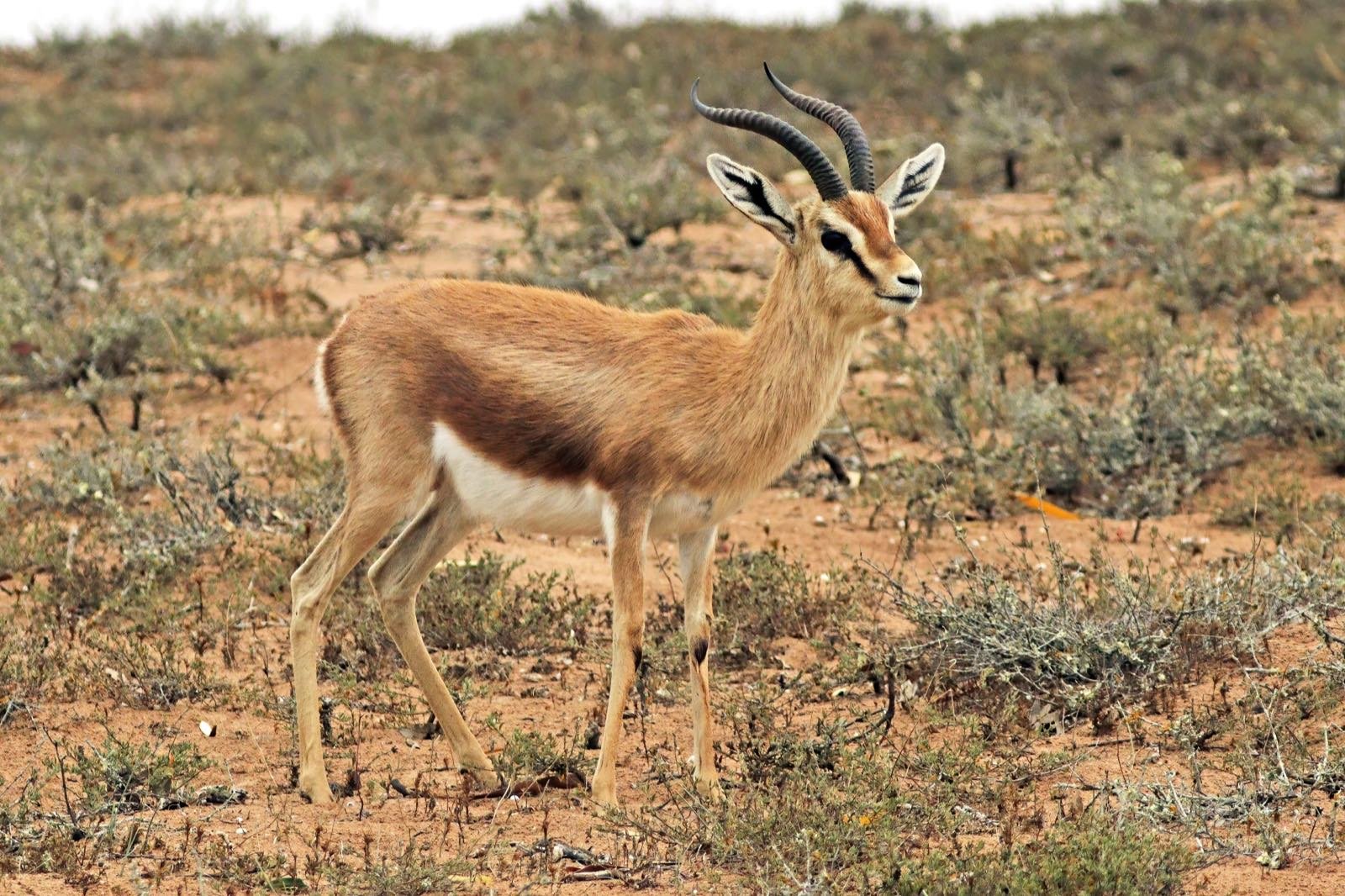
The Negev gazelle is a desert gazelle, and it does something that is hard to believe: it can live in the desert without drinking water.
How? It gets the water out of the food. It eats the leaves of the acacia — the most common tree in the deserts of Israel — and in those leaves there is enough moisture to keep it going. That is, the tree is not only shade for it. It is also the tap.
And in its body you can see the adaptation to the desert. Its back is light brown, and a light color absorbs less heat than a dark one. Its ears are larger than those of the mountain gazelle, and that too is important: a large ear with many blood vessels is a way of releasing heat from the body without sweating, that is, without wasting water. Its tail too is longer.
It lives in the south of Israel — in the Judean Desert, in the Arava valley and in the southern Negev — and also in Sinai, in Jordan and in the arid deserts of North Africa.
And between the gazelle and the acacia there is a deal, and both sides gain from it. The tree gives the gazelle water and food and shade — under its canopy the temperature is lower than in the surroundings. And in return, the seeds of the acacia are spread mainly by the Negev gazelle: it eats the pods, walks, and the seeds come out of it in another place. A tree cannot walk. The gazelle walks for it.
And here comes the encouraging part. In 2009 only 652 individuals were counted in Israel. That is a small and frightening number. In 2021 already 2,061 were counted, and in 2024 — 2,132.
That is, the population grew about threefold in fifteen years. That did not happen by itself. It happened thanks to protection.
And in the tests it also became clear that there is significant genetic variation in the population, and that is a very good sign. A population all of whose individuals resemble each other has difficulty in the face of a single disease; a varied population copes better with diseases and with changes.
It is still defined as 'vulnerable' on the Red List of the International Union for Conservation of Nature. But the direction of the numbers is upward, and that is not self-evident anywhere in the world.
Sources
- צבי הנגב — ויקיפדיה העברית
- שיטה סלילנית — ויקיפדיה העברית
- Photograph: Charles J. Sharp · CC BY-SA 4.0