
Places
A Well You Can Dig by Hand
To remember
On a stone at Abraham's Well an inscription in Arabic from the year 1112 is carved.
At the gates of the Old City, on the bank of Nahal Be'er Sheva, there is an ancient water well. Early tradition attributes it to Abraham our father, and it is a heritage site.
And its measurements tell a story. Its depth is 13.5 meters, of which about five are hewn in the rock, and its diameter is 3.75 meters. It is lined with dressed stones down to the bottom.
Now pay attention to the depth, because that is where the whole point is. 13.5 meters is not much for a well. And the reason is that the water here is close: groundwater seeps through the loess soil and gathers at a shallow depth near the stream.
A well of such a depth can be dug without machines. And that is exactly what makes this place a place you can live in.
And beside it there is another well, dug apparently later — that is, one well was not enough here.
And the word lined is important here. A well is not just a hole in the ground: its walls may collapse inward and block it. So a lining is built for it — a facing of dressed stones, from the bottom all the way up. The lining is the reason a well hundreds of years old still stands open, and did not close up by itself long ago.
And how old are they? In the 19th century two archaeologists examined them, Edward Robinson and Henry Tristram, and determined that the well is more than a thousand years old and that it already existed at the beginning of the Crusader period. And there is evidence you can actually touch: an inscription carved in stone, in the Arabic language, from the year 1112.
When Ottoman Beersheba was founded the well was included within the gates of the city, the one that is called today the Old City. In 1948, after the battle for the city, the well was left as a public archaeological area. The municipality developed its surroundings, paved the plaza that leads to it, and enclosed it with a wall.
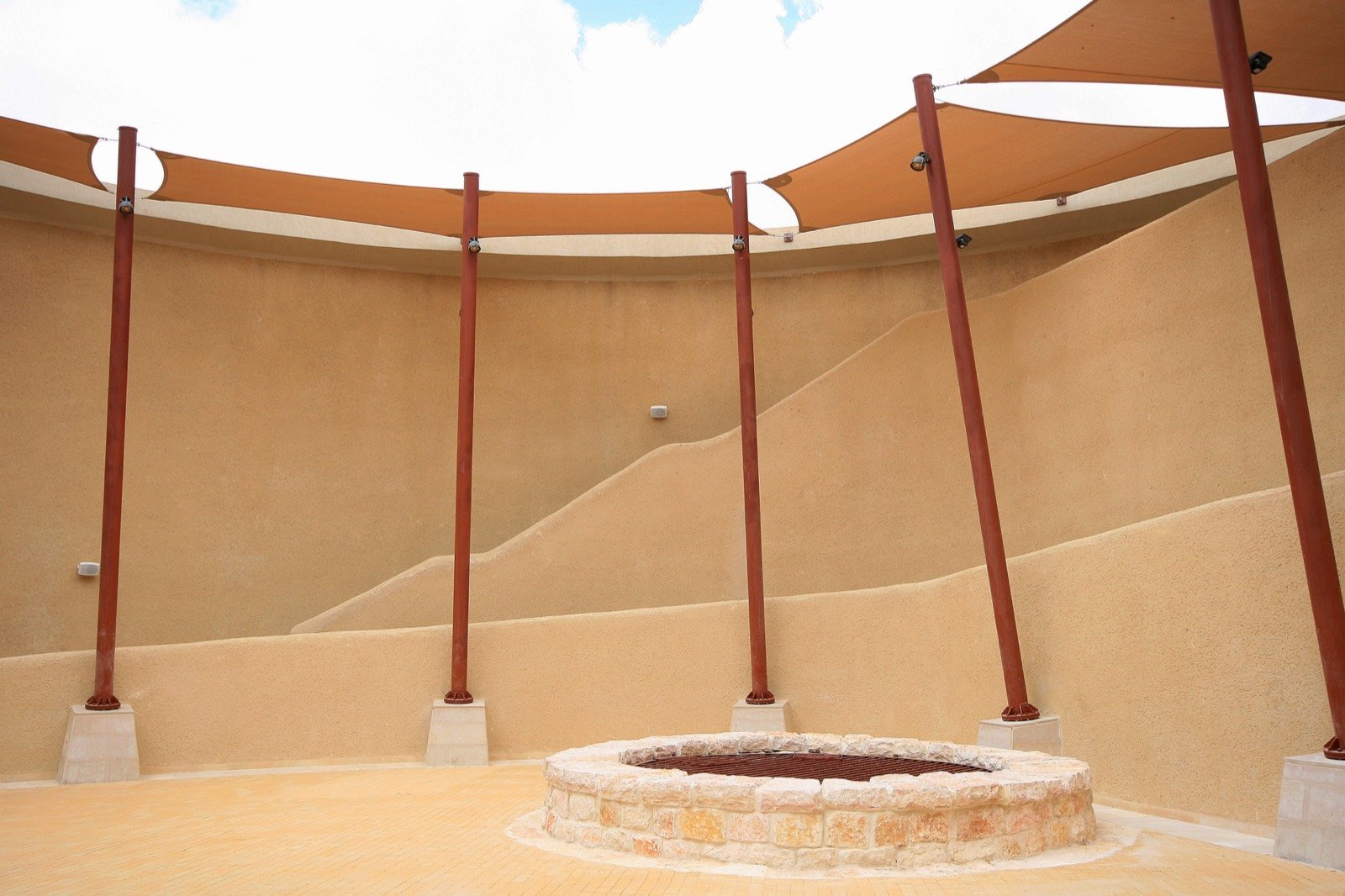
And in October 2013 a visitor center was inaugurated at the place. It was designed by the architect Eli Armon, and it was built on the foundations of the courtyard of the ancient well. Its form evokes a tent, and it combines the colors of the desert with the color of copper. The whole site deals with the figure of Abraham, and inside it an exhibition of photographs on the history of the city is also displayed.
Sources
- Photograph: Abrahams Well · CC BY-SA 3.0
- Photograph: Boris Carmi, אוסף מיתר — הספרייה הלאומית · CC BY 4.0
- Photograph: Boris Carmi, אוסף מיתר — הספרייה הלאומית · CC BY 4.0
- Photograph: Australian War Memorial (C385795) · נחלת הכלל