
Places
A Bridge of Twenty Arches
To remember
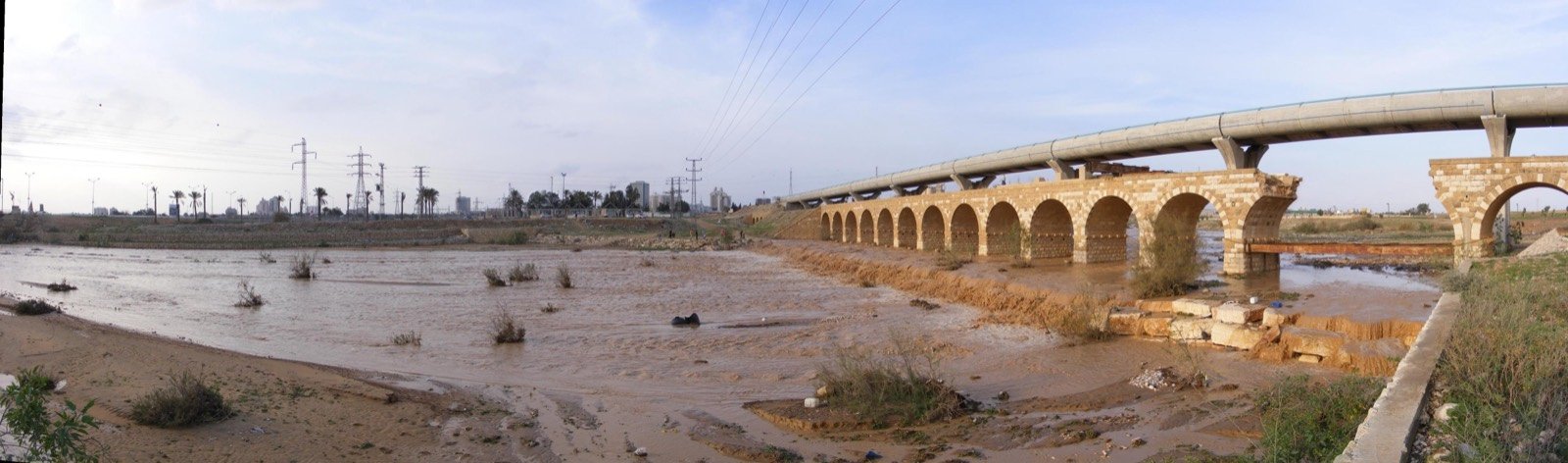
The Turkish railway bridge has twenty arches and its length is 190 meters, and it was built in about six months in 1916.
South of the city, over Nahal Be'er Sheva, stands a long stone bridge. Its length is 190 meters, and it has twenty semicircular arches — five in the northern section and fifteen in the southern. It is built of yellowish dressed stone.
It was built in 1916, for a railway line.
The plans were drawn up by a German engineer named Josef Wennagel, an architect who had worked earlier on the Berlin–Baghdad railway. The execution was directed by the railway engineer Heinrich Meissner. And the building itself was done by two Jewish contractors, Michael Ehrlich and Eliyahu Yanovsky, who won the tender and recruited about a hundred and fifty workers, as well as stonecutters and masons — a large part of them immigrants from Yemen.
And this work was very hard, and it is worth knowing how hard.
It began in January with the digging of pits for the foundations. And then a flood came and destroyed the foundations. Afterwards a typhus epidemic broke out in the city, and many of the workers fell ill. And workers were also killed by British bombardments, which were meant to halt the construction.
In spite of all this the bridge was built in about six months. It cost eleven thousand French francs — and the payment for them arrived only after a whole year, after the money had already lost its value.
And why arches, and not a straight beam? Because stone is very strong in compression and weak in tension. An arch turns the weight above it into compression only, and it passes it sideways and down, to the piers that stand in the stream. That is why a bridge of 190 meters can be built without a single drop of metal — and that is exactly what was done here.
And how long did trains travel over it? Very little. Its use as a railway ceased already in May 1917. Until 1920 the traffic between Beersheba and Bir Asluj passed over it.
After the establishment of the state an asphalt road was laid on it, and in 1962 it was closed to vehicle traffic. In 1965 one of its piers collapsed in a flood.
And in 2017, ahead of a hundred years since the battle for Beersheba, it was renovated. Since then pedestrians cross over it, in Nahal Be'er Sheva Park.
Sources
- Photograph: Amirber · CC BY-SA 3.0
- Photograph: ישי גוריון · CC BY 3.0