
Climate
What Is a Desert
To remember
An area is defined as desert if less than 200 millimeters of precipitation fall in it in a year — a desert is measured in rain and not in heat.
Most people think that a desert is a hot place. That is not accurate. What determines whether a place is a desert is how much rain falls in it, and not how hot it is. The accepted definition is simple: an area is defined as desert if less than 200 millimeters of precipitation fall in it in a year.
In the Negev you can see this nicely, because its boundary is marked in rain. The northern boundary of the Negev is the line where on average 300 millimeters of rain fall in a year. South of there the rain goes on diminishing, and there is another line — the line of 200 millimeters. These two lines are not drawn on the ground. They are an average of many measurements over many years.
200 millimeters is 20 centimeters of water in a whole year. And even that small quantity does not fall gradually: it falls on a few days in winter, sometimes in a few hours, and the rest is long months without a drop.
And there is a big difference between an average and what happens this year. One year can bring double the average, and the year after it almost nothing. In a place where 800 millimeters fall, a weak year is still enough. In a place where 200 fall, a weak year is a drought. That is the reason that in the desert you always build for the bad year and not for the average.
And how much actually falls here? In the northern Negev about 200 millimeters a year. In the central Negev already only 75 to 100. In Eilat and the Arava 20 to 50 millimeters. That is, inside the Negev itself there is a tenfold difference between the northern end and the southern end.
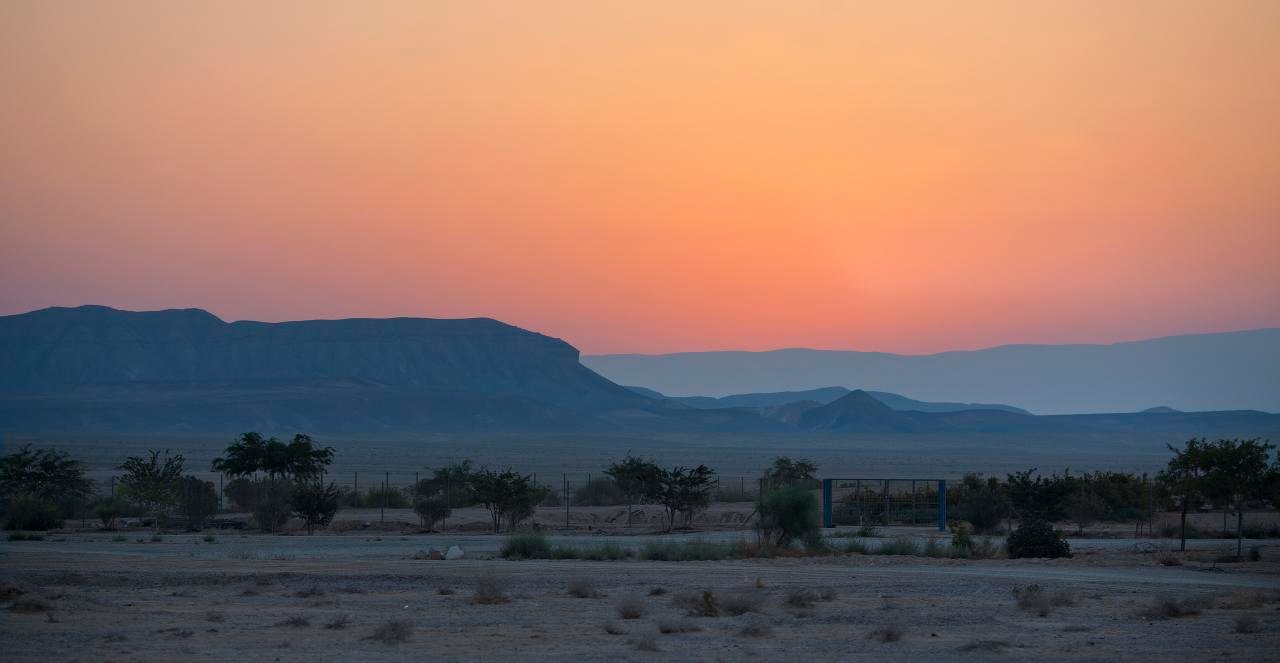
And there is another thing you feel in your body. In an arid and hot climate there is a large temperature range — that is, a great difference between the temperature by day and the temperature at night. That same day which was very hot can be a night in which you need a sweater.
And so a desert is not a place without life. It is a place where the life in it is arranged around water that comes in small quantity and not at a fixed time. The plants wait. The animals come out at night. The people who lived here dug wells and built dams in order to catch the floodwaters, and Beersheba itself was built in a place where the water can be reached.
The Negev takes up about 58 percent of the area of the State of Israel — about 13,000 square kilometers. That is, more than half of the country is the area in which the rain is measured in lines.
When you say 'desert', what you are really saying is a sentence about rain.
Sources
- נגב — ויקיפדיה העברית
- מדבר — ויקיפדיה העברית
- אקלים ארץ ישראל — ויקיפדיה העברית
- אקלים צחיח — ויקיפדיה העברית
- Photograph: Christopher Michel · CC BY 2.0