
Geography
The Makhtesh Is Not a Pit
To remember
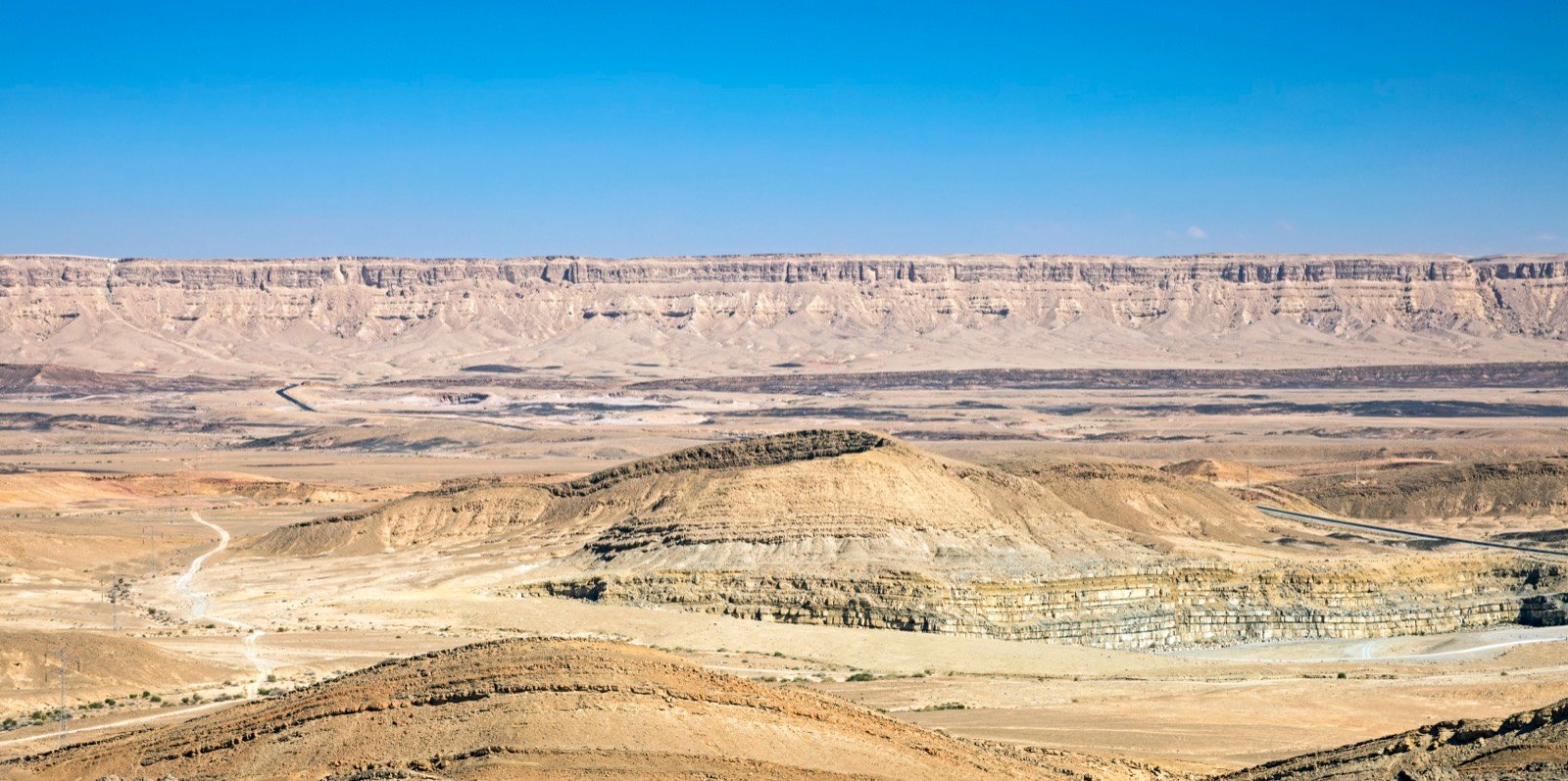
Makhtesh Ramon was not formed by a meteorite — it is a mountain whose inside weathering took out. Its length is about 40 kilometers.
Makhtesh Ramon looks like a huge hole in the ground, and so people assume that a meteorite struck here. That is not true, and the truth is more interesting.
A makhtesh is not formed by an impact. It is also not the crater of a volcano. It is formed by weathering — that is, by the slow work of water, of wind and of temperature on rock, over millions of years.
And this is how it happened. In the place where the makhtesh is today there was once a mountain. The rock layers arched upward and formed an anticline, the Ramon anticline. The rock at the top of the anticline was softer than the rock at the edges. Water penetrated inside, wore away the soft rock, and swept it out. The hard edges stayed in their place. What was left is a huge bowl surrounded by cliffs — and those cliffs still face toward the top of the mountain that is no longer there.
So a makhtesh is not a pit. It is a mountain whose inside was taken out of it.
And the measurements: the length of Makhtesh Ramon is about 40 kilometers, its maximum width about 9 kilometers, and its maximum depth about 350 meters. It is the largest of the five makhteshim in the Negev, and there are makhteshim in Sinai too.
And how do you know there was a mountain here, if the mountain is not there? You look at the direction of the layers. The rock layers in the walls of the makhtesh do not lie straight — they slope, and each of them faces toward that same point in the air, above the center of the makhtesh. There was the top of the mountain. The layers go on pointing at it even after it has disappeared, like branches that go on coming out of a trunk that has been cut down.
Because the inside of the mountain was taken away, you can see today inside the makhtesh the layers that were inside it. Rocks that were formed at depth are exposed on the surface, and different colors mark different periods. Whoever drives through the makhtesh drives inside a mountain, even if it does not feel that way.
And one last thing about time. The weathering that created the makhtesh did not happen in one event, and you cannot see it happening. It has also not finished: every flood in winter takes a little more rock and carries it out. The makhtesh that is seen today is not identical to the makhtesh that was seen here a thousand years ago, and not to the makhtesh that will be here either.
Sources
- מכתש רמון — ויקיפדיה העברית
- מכתש — ויקיפדיה העברית
- Photograph: Godot13 · CC BY-SA 4.0