
Plants
The Shrub That Loses Its Leaves on Purpose
To remember
The white broom sheds its leaves and carries out photosynthesis through the green branches — that is how it saves water.
The white broom is a tall shrub, of the legume family — the same family in which the pea, the lentil and the chickpea are too. Its height is between one meter and five meters, and it branches a great deal.
Whoever looks at it closely notices a strange thing. The branches are green.
That is no accident, and it is an especially fine adaptation to the desert. A leaf is a large, flat organ, and through it a great deal of water evaporates. The broom does have leaves — simple, small, narrow and silvery — but it sheds them, and carries out most of its photosynthesis through the green branches themselves. That is, instead of giving up the production of food, it gives up the organ that wastes water, and passes the job to the branch.
And why does it matter that it is of the legume family? Because that is the family that knows how to do the trick with nitrogen. Nitrogen is one of the substances every plant needs in order to grow, and in the air there is a great deal of it — except that plants cannot take it from there by themselves. The legumes solved this in partnership with bacteria, and so they succeed in places that other plants give up on.
Its flowering is among the most beautiful there is in the Negev. The flowers are white with purple veins, their length is 10 to 15 millimeters, and they are fragrant. It blooms from the end of January to the beginning of April, and the peak of the flowering is in February — that is, exactly at the end of winter, when there is still moisture in the ground.
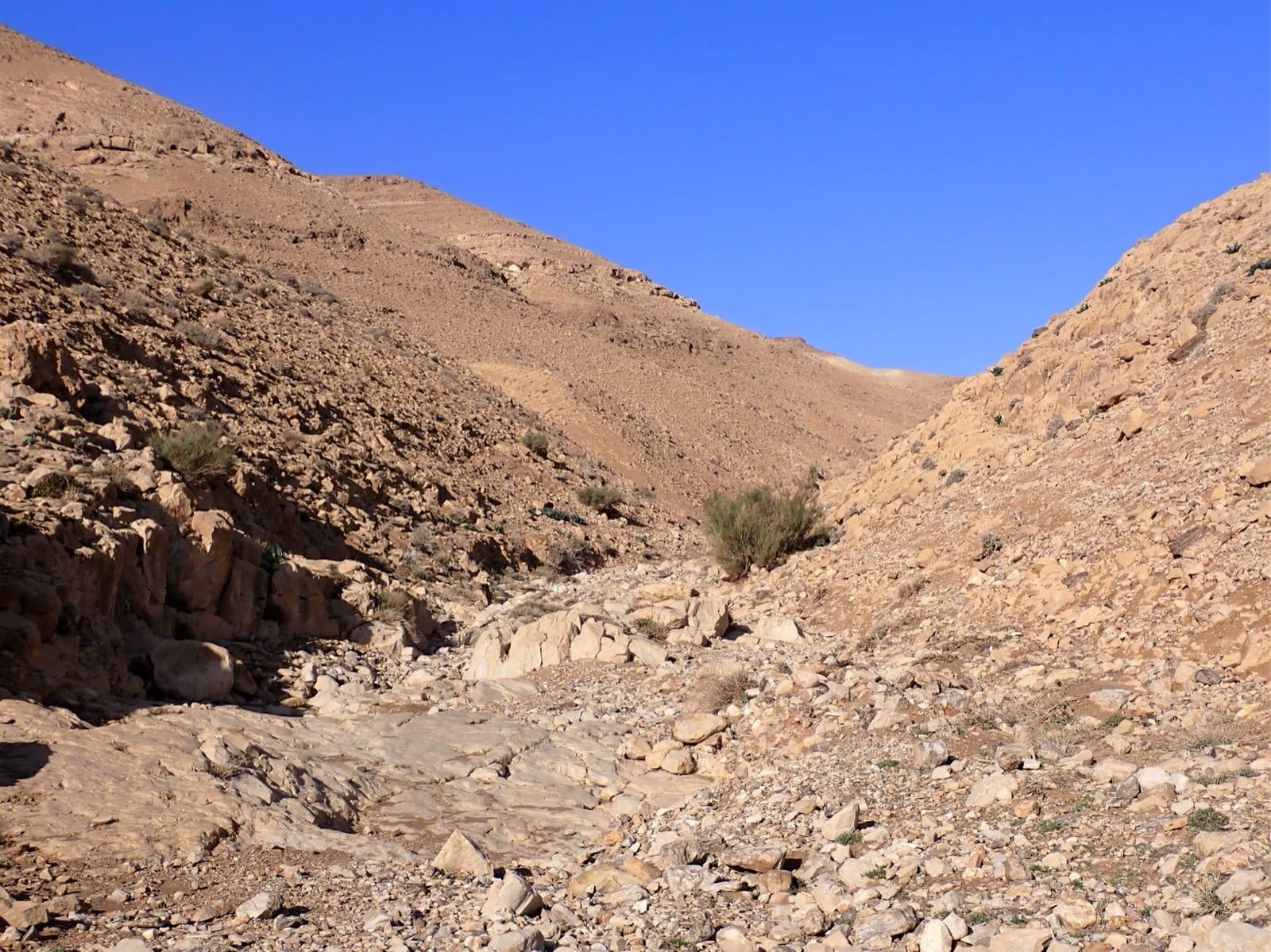
In Israel it is fairly common in the sand areas of the northern Negev, in the Judean Desert, in dry streambeds throughout the desert area, in the Jordan Valley and in the sands of the coastal plain. And outside Israel it grows in southern Sicily and in North Africa — in Morocco, in Algeria, in Tunisia, in Libya and in Mauritania.
And the broom has a role that is hard to appreciate from above: it stabilizes dunes. Sand travels with the wind, and roots hold it. That is why broom is planted in order to bring vegetation back to areas that have been damaged.
And its partners in the matter of nitrogen are bacteria called rhizobium, which live inside its roots. They fix the nitrogen from the air and turn it into a form the plant can use. That is, the broom does not only grow in poor soil — it enriches it, and leaves it better than it found it.
Sources
- רותם המדבר — ויקיפדיה העברית
- Photograph: Krzysztof Ziarnek, Kenraiz · CC BY-SA 4.0