
Plants
One Tree Is a Whole Neighborhood
To remember
The roots of the acacia reach up to forty meters from the tree — not into the depth, but to the sides.
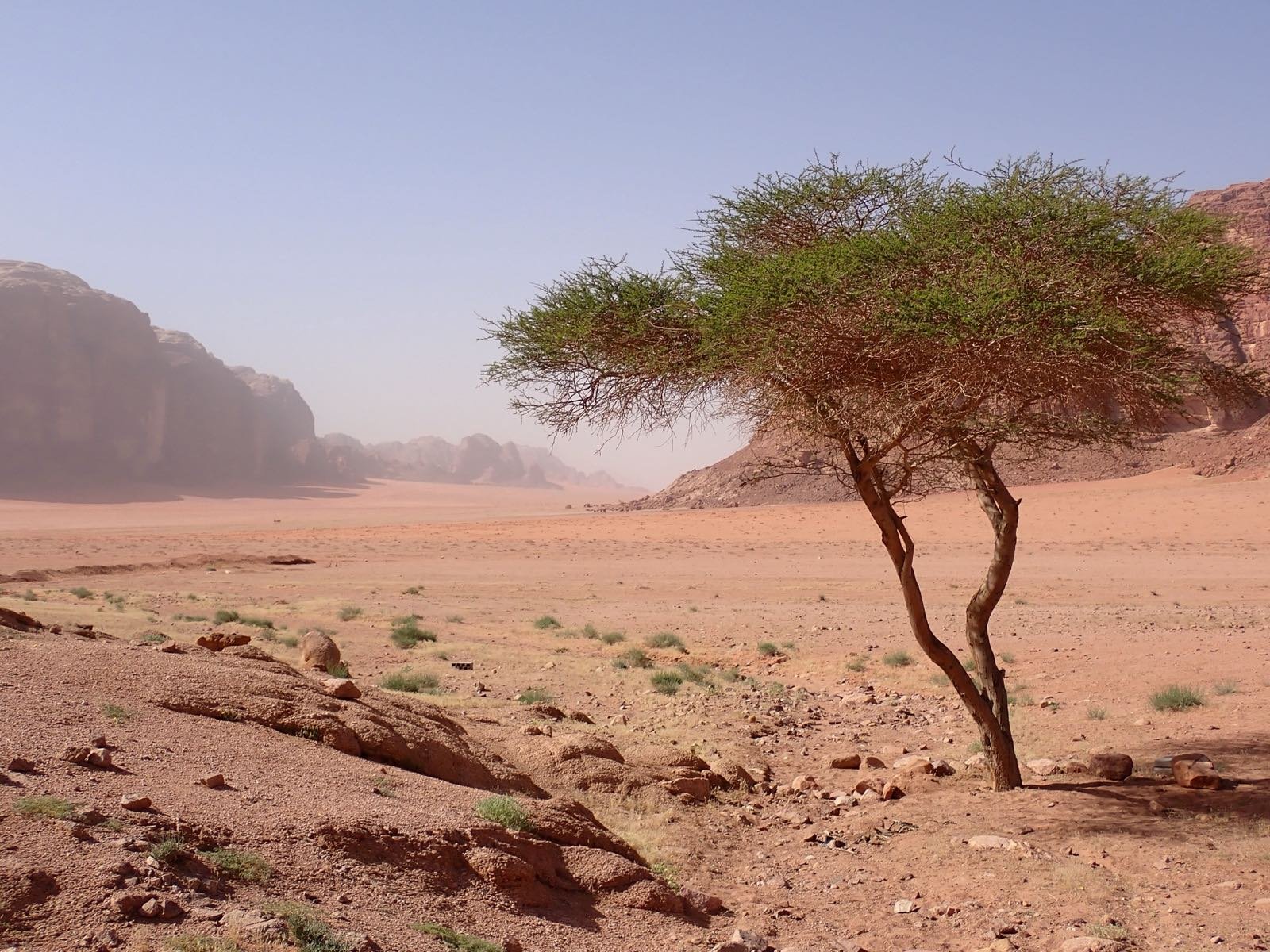
The umbrella thorn acacia is the most common tree in the deserts of Israel. It dominates most of the desert wadis, and especially along the Arava. If you have seen a lone tree in the middle of ground that looks completely empty — it is reasonable to assume that it is an acacia.
And the first question is how a tree holds out in a place where a few dozen millimeters of rain fall in a year.
The answer is under the ground, and it is not what most people guess. The roots of the acacia can reach a distance of forty meters from the tree. Not forty meters down — forty meters sideways. And most of the roots are directed precisely toward the sources of water in the upper layers of the soil, and not toward the depth.
That is, one tree drinks from an enormous area around it. And that is also the reason acacias stand far apart from each other at great distances: each tree needs its own ground, and there is no room for crowding.
And why in the wadi of all places? Because that is where the water passes. After rain, everything that gathers in the drainage basin flows in the channel, and part of it is absorbed into the ground beneath the channel and stays there. The wadi is the moist strip of the desert, even when it looks completely dry — and the acacia sits exactly on it. The map of the acacias is in fact the map of the water.
And why is the acacia so important? Because of the shade. The shade cast by the branches of the acacia protects the living creatures that exist in its surroundings from the strong radiation of the sun. In the desert, shade is not a matter of comfort — it is the difference between living there and not living there.
And so the acacia is called a keystone species, that is, a species on whose existence many animals depend. Insects, reptiles, birds and mammals live on it, inside it and under it. One tree is a whole neighborhood, and when it dies the whole population of the neighborhood disappears with it.
And it gets something in return. Its seeds are spread mainly by gazelles, which eat the pods, walk on, and the seeds come out of them in another place. The tree can never move from its place; the gazelle moves for it.
And so, when you pass by a lone acacia in a wadi, you are not passing by a tree. You are passing by the place where there is life in this environment.
Sources
- שיטה סלילנית — ויקיפדיה העברית
- Photograph: Krzysztof Ziarnek, Kenraiz · CC BY-SA 4.0