
Places
A Train from Damascus
To remember
The Turkish track was 105 centimeters wide, and the British 143.5 — and that is why the British closed the lines.
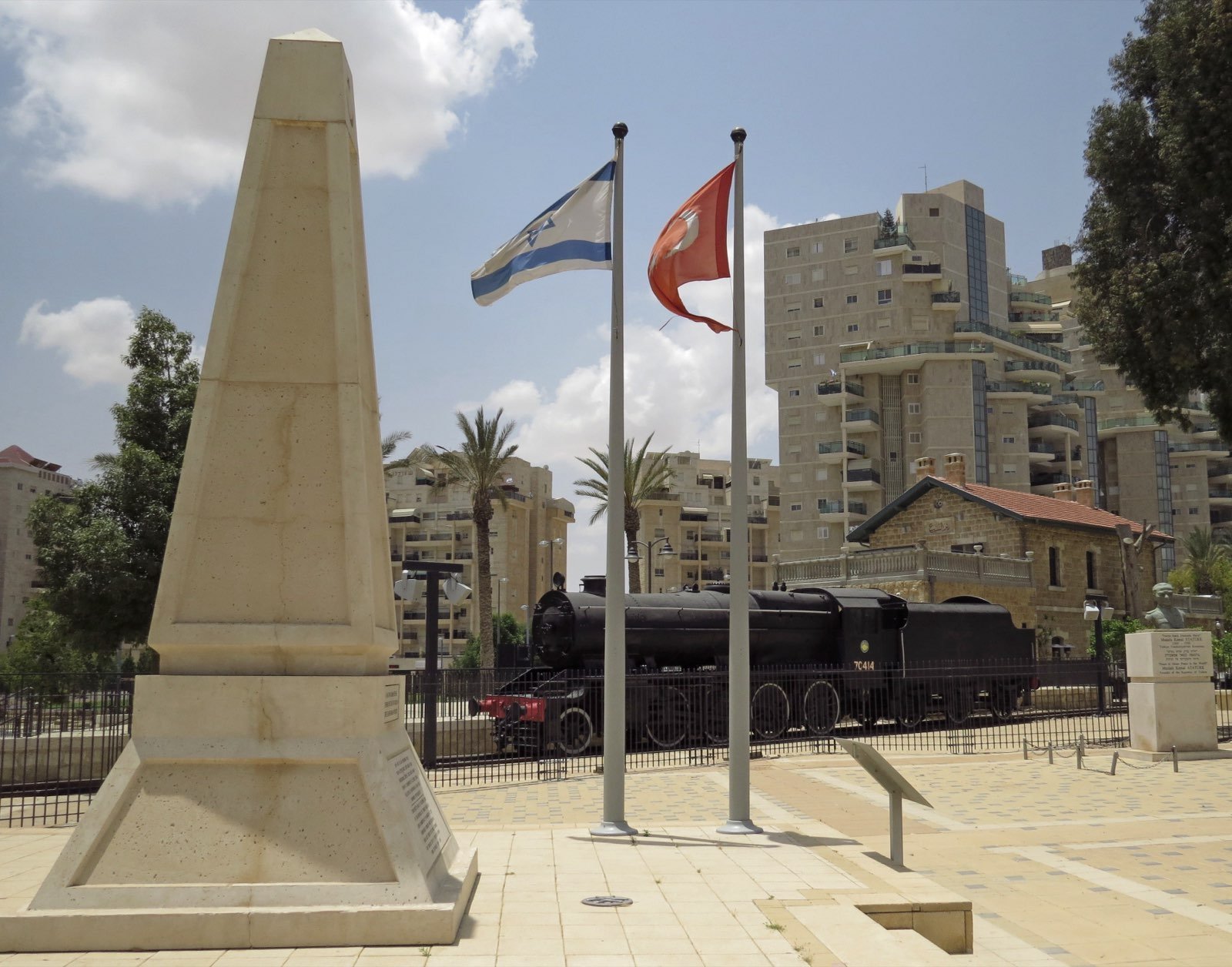
North of the Old City stands a compound of stone buildings, and it was once a main railway station.
The Ottomans built it in 1915, on the branch that led from Nahal Sorek to Kusseima. And this was not a passengers' line: it was part of the military effort in the First World War, in the campaign for the Suez Canal and for Sinai.
The director of the works was a German railway engineer named Heinrich August Meissner, and that same man contributed much to the building of the whole Ottoman railway network, including the Hejaz railway.
In the compound were built a terminal building, a building for the station manager, a workshop for locomotives, and a water tower for cooling their boilers.
And in October of that year the line was inaugurated in a ceremony. To it came a special train from Damascus, carrying the Turkish supreme commander Djemal Pasha, Ottoman and German officers, and European consuls.
At the beginning of 1917 the British air force bombed the station. Sixteen Jewish workers were killed, and were buried in a common grave.
And at the end of October of that year the British army entered the city — and then something interesting happened. The Turkish track was narrow: its width was 105 centimeters. The British track was wider, 143.5 centimeters. The British preferred their own. In 1919 most of the lines were closed, and in 1927 the train traffic at the station ceased entirely.
And this difference is bigger than it sounds. The distance between the two rails is called the gauge, and a locomotive is built for exactly one distance. A locomotive of a wide track cannot travel on a narrow track, and not the other way round either. That is, two networks with a different gauge are not one big network — they are two separate networks that meet and stop.
From 2013 the Beersheba municipality and Israel Railways rehabilitated the compound. Today it has an archive for the heritage of the city, historic carriages more than a hundred years old, and a steam locomotive whose number is 70414 — and the place is named after it. From a station of war it became a center of culture and leisure.
Sources
- Photograph: Shlomo.abitbul · CC BY-SA 4.0
- Photograph: American Colony Photo Department / Matson Photo Service — Library of Congress · נחלת הכלל