
Places
The Hill That Is a City
To remember
In 2005 Tel Be'er Sheva entered the UNESCO World Heritage list, together with Megiddo and Hazor.
Three kilometers east of Beersheba stands a hill, between the city and the locality of Tel Sheva. And it is not a natural hill.
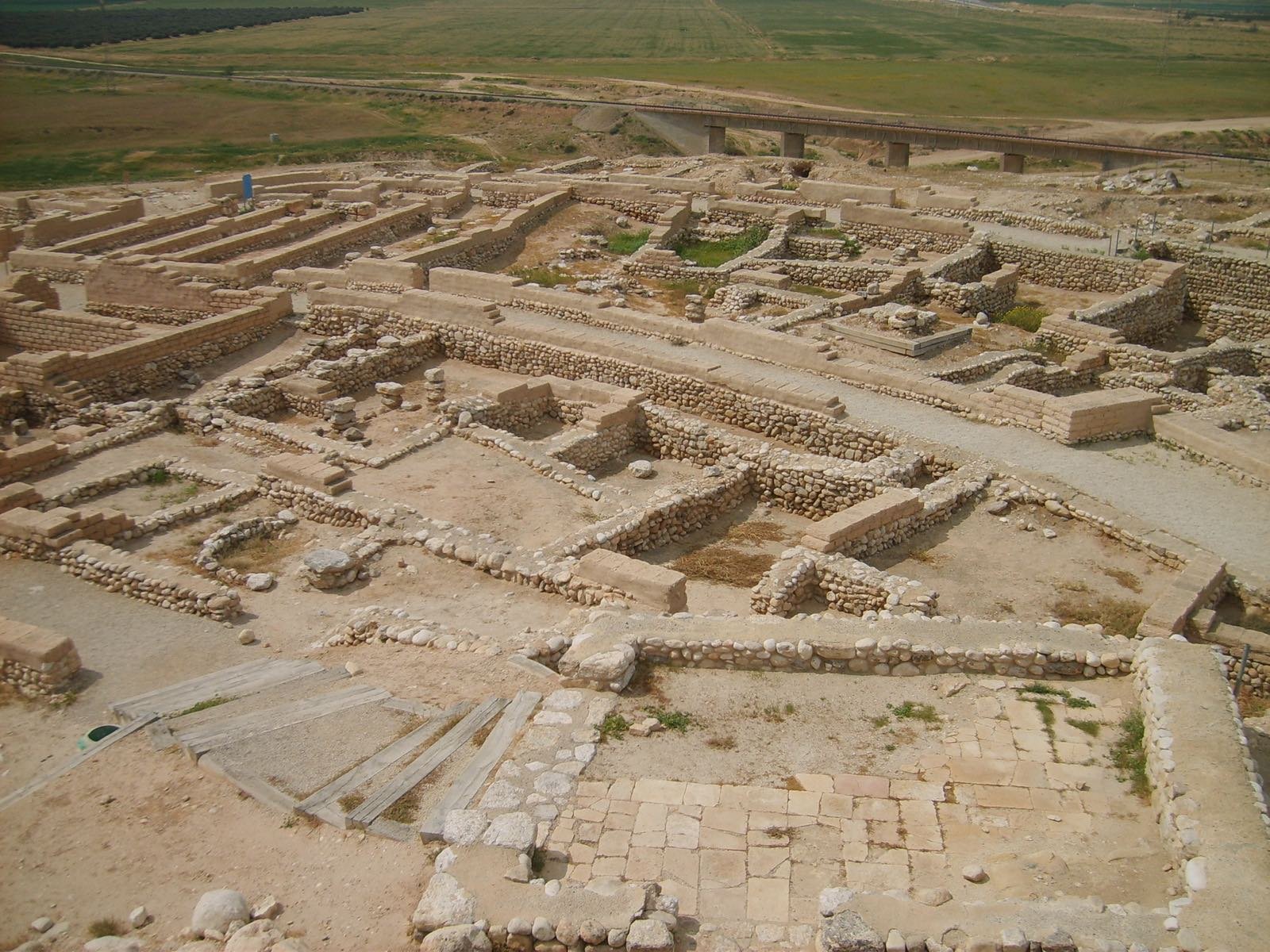
This is an ancient city, buried inside its own earth. Archaeologists dug here between the years 1969 and 1976, and what they uncovered is a fortified Israelite city.
It had a casemate wall — a double wall, with rooms between its two faces — and a city gate of four chambers. Such a gate is not just an opening in a wall. It is a whole building, and one can fight inside it.
And inside the city they found something with nothing like it: the stones of a large altar with four horns. This was the first horned altar uncovered in Israel. The original altar is displayed today at the Israel Museum in Jerusalem, and at the tel itself a reconstruction of it stands.
And this city had two water systems, and both still stand. One is a well outside the wall, next to the gate, and its depth is 69 meters. The second is inside the wall, and was meant for a time of siege: a dam built on Nahal Hevron gathered the floodwaters, a covered channel carried them to a reservoir hewn in the rock, and from the city they went down to it by a flight of stairs inside a shaft.
The site is identified with biblical Beersheba, that is, with the city that appears in the stories of the patriarchs.
And in 2005 the tel entered the UNESCO World Heritage list. It did not enter alone: it entered together with Megiddo and with Hazor, under one joint name — the Biblical Tels. Three tels, in three different regions of the country, that together are considered an example of one thing.
And since 1990 the site has been open to visitors as a national park. You can go inside, walk along a street of the city, and stand inside the gate — that same gate of four chambers that was built so that one could fight inside it, and that stands today open to everyone who comes.
And one last thing, so that no one gets confused. East of the tel there is a locality named Tel Sheva, and that is an entirely different place: a Bedouin local council founded in 1968. Two similar names, neighbors of each other, and between what each of them marks there is a gap of thousands of years.
Sources
- Photograph: gugganij · CC BY-SA 3.0