
Animals
The Largest Predator in the Country
To remember
The striped hyena is the largest predator in the country, and in Israel only about a thousand adult individuals remain.
The largest predator in the Land of Israel is not a wolf and not a leopard. It is the striped hyena, and it lives in the Negev too — but almost nobody sees it.
The reason is simple: the hyena is a nocturnal animal. It comes out of its den when the darkness is already completely full, and returns to it before sunrise. Whoever is out and about at those hours is the hyena, and not us.
And by its measurements it really is large. The body length is 85 to 130 centimeters, the tail another 25 to 40, the shoulder height 60 to 80 centimeters, and the weight between 22 and 55 kilograms.
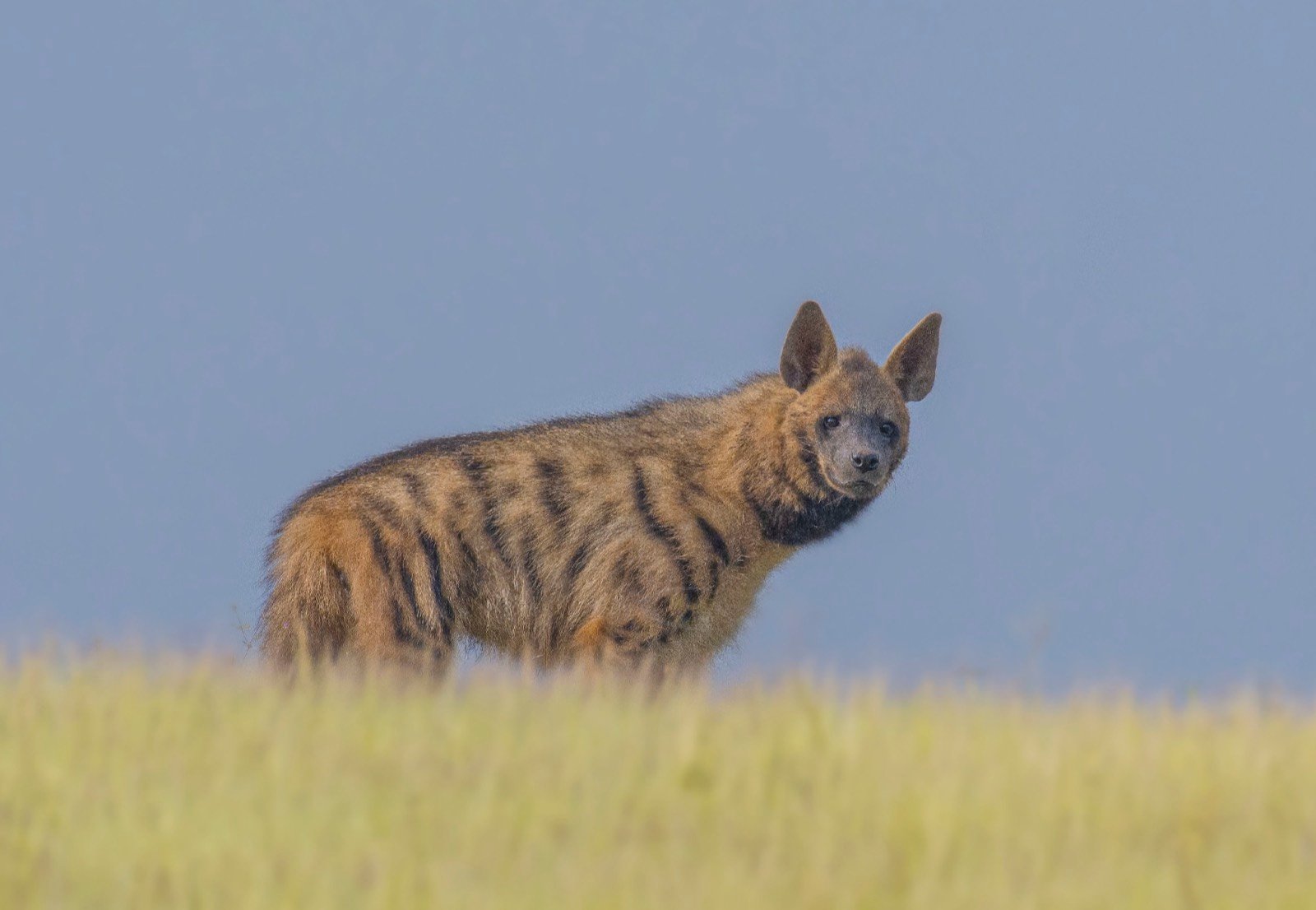
And where does the name come from? From the stripes. On its legs and on its body there are dark stripes, and on its neck and back there is a mane of long hair that it raises when it is startled. A striped animal with a raised mane looks bigger than it is.
Its strength is in its jaw. Its bite is strong enough to break the thigh bone of a camel. And this is not just strength: the hyena eats mainly carcasses, and inside them it eats what other predators leave — bones, cartilage and bone marrow. It is able to break down and digest things that another body cannot. Sometimes it also hunts a live animal, when the chance comes, and in Israel it also eats rubbish, and carrots and fruit as well.
And that brings us to the important part. The hyena is the cleaner of nature. It removes carcasses, and in that way it prevents diseases and returns materials to the ground. Without hyenas what has died stays in the desert.
And there is another hyena in the world, the spotted hyena that lives in Africa, and it is better known from films. The two species are not identical: the teeth of the striped hyena are slightly smaller than those of the spotted one, and it hunts much less and eats far more carcasses.
In Israel only about a thousand adult hyenas live, and the species is defined as endangered. It is protected by law. And still, the nature reserves that exist today are not enough to sustain a population that reproduces by itself over time — that is, to protect the hyena is not only not to harm it, but also to see that it has enough ground.
Sources
- צבוע מפוספס — ויקיפדיה העברית
- Photograph: Rushikesh Deshmukh DOP · CC BY-SA 4.0